Wednesday, April 11, 2018

Plump, Prosperous Pecs

This post is a month overdue, but in my defense two big events occupied much of the last month. First was my triumphant return to the stage of the local Liszt society, a performance about which my teacher told me, in characteristic fashion, I can be "half happy," which is equal to "half miserable" by my calculations. As in any unhealthy relationship (captor/hostage, bully/victim, Sonny/Cher) this all seems perfectly natural to me. Some gems from Bela's lessons leading up to the event:

"That was better than I thought it was going to be"
"You made fewer mistakes than I expected"
"Actually, the last page was not bad"

and, after I jokingly started taking his possessions from a table while I was leaving the lesson, and without missing a beat I might add,"And yet you don't steal any of my knowledge!"

Ouch. However, I have since come to realize that this is mild by Hungarian standards, as I learned during a piano masterclass today with a teacher from the Liszt Academy just down the (three hours by train) road. The zingers flew fast and furious, but here are three that stood out:

(during a particularly chaotic passage) "It's like the Afghan War: everyone's shooting at each other"
(At a march-like section) "Oh dear, now we're in Nazi Germany"
"Don't stop here; there's no passport control"

The second reason for my delay was a training trip for a tour I'll be running this summer of Romania, Serbia, and Croatia, or as they're known in these parts, "Greater Hungary." By the way, they love it when you say that in those countries. I especially enjoyed my time in Transylvania, though I think a local nobleman followed me home. Yes, the other night I was visited by this handsome fellow, who flew in my window and proceeded to circle the chandelier like a plane in a constant holding pattern:
"Can I be your most rabid fan?"
Thinking quickly, I called the neighbors who sent their daughter, a future vet, to deal with the situation while I heroically cowered in the corner. Eventually the disoriented shapeshifter was caught (passive voice; by me or the neighbor, who can remember?) and released to fly home, no doubt to the menacing ruins of some fortress on a hill somewhere.

Speaking of Transylvania, it's interesting to note that it was a semi-autonomous province while most of Hungary was under Ottoman rule, and consequently was the place of origin of the first of several failed attempts to regain Hungarian independence, the Rakoczy Rebellion in the early eighteenth century. Ever risk averse, Pecs prudently remained loyal to the Habsburgs...resulting in Rakoczy's army pillaging the town. Nevertheless, the city recovered, was eventually granted Free City status in 1780, and evidently was not a major player in the 1848 revolution either, though my street pays tribute to the 13 Martyrs of Arad, Hungarian generals hanged for their role in the rebellion.

Not sure how I feel about living on such a morbid street.
                                       
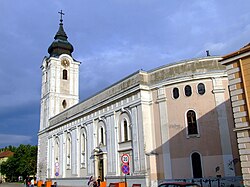
The situation in Hungary finally stabilized through the Compromise of 1867, returning a degree of autonomy to the eastern part of what became known as the Austro-Hungarian Empire. Industry flourished in Pecs: a brewery, Littke champagne...er, sparkling wine, Angster pipe organs, and Zsolnay Ceramics, which will be the subject of my next and final post. Many of the most impressive buildings of the city date from this period, which I will now show in no particular order. First is doubtless the most impressive, the Neo-Romanesque cathedral, a rebuilding of the medieval structure finished in 1891.

Of views I have held out my window, this is somewhere between a glaciated mountain and a brick wall.


Next is Kossuth Square, named after the hero of the 1848 revolution honored with a statue in its center.


To the right of the Square is the Synagogue, still in operation.


 Interlude: much of my knowledge of this era was aided by a recent visit to the City Museum of Pecs, tucked away in a nondescript side street and evidently forgotten by all. With some hesitation, I rang the bell and, after a good five minutes, I heard footsteps and a woman of a certain age answered the door. As she stared at me in astonishment, I managed to communicate my interest in visiting the exhibit in my halting Hungarian. Shrugging in acquiescence, she shuffled back to her desk, blew the dust off a comically large key, and unlocked the museum. A relic of the Communist era, most information therein was either typed or handwritten on yellowing paper in Hungarian and German, the latter language offering me at least a fighting chance. Particularly enjoyable were the 3d models and charts tracking the development of the city through the ages:

The walled city of Pecs: cathedral and bishop's palace in NW corner.

Model of the former town hall.

Photograph of Cathedral before rebuilding; note lower towers without spires.
Chart showing ethnic makeup of Pecs over the years. "Német" is the German minority.


 What follows are buildings I pass on a daily basis:

Former home of Littke Champagne; the cellar is now a restaurant.


Nador (Palatine) Hotel, the first hotel in town, sadly now unoccupied.

Town Hall, with statue of John Hunyadi.

County Hall

Hotel Palatinus, a beautiful Art Nouveau building.


The Theater, a Neobaroque monstrosity.
Statue commemorating Franz Liszt's lone visit to Pecs in 1846.


Plaque commemorating the same visit on the house where Liszt performed.

Cathedral Square after an unseasonably late snowfall.

Administrative building of the University, notable for its Atlases and fading splendor.

Evidence of lick-and-stick facade over brick, hallmark of nineteenth century building methods.
 This post will be on the briefer side, but this is merely the lead-up to the grand peroration in which I will brilliantly tie everything together, finally giving Hungary the special treatment it deserves...or finishing the job the Ottomans started.


Wednesday, January 31, 2018

Back to intensive Pecs training/Purely ornamental Pecs

This post will conclude with the obligatory next stage in our journey through Hungarian history, but first I will address the question that is no doubt on everyone's lips: has my piano teacher broken my spirit yet? What well-timed barbs has he aimed at me to shatter what's left of my faith in my abilities? Have I smashed my piano in a fit of desperation and taken holy orders, resolving never to return to Hungary?

To my surprise, it's actually going well! I think the non-debacle of my concert last February was a turning point and has led to some grudging gestures of respect on the part of "Bela." In fact, in the fall he invited me to join him in giving a series of concerts in smaller towns throughout Hungary, the first of which took place in the bustling vacation town of Siofok on Lake Balaton. Bela tossed off a lengthy improvisation in the style of Rachmaninoff like it was nothing, while I expended considerably more energy playing a Liszt piece and Beethoven Sonata, quite well I thought.

At our lesson the next week, Bela, master of the left-handed compliment, opened with this gem: "Andrew, you played the Liszt as well as anyone could have on that terrible piano. Now, the Beethoven on the other hand..." Well played Bela, well played. During the two hours that followed, all the old fan favorites made an appearance: 
  • "are you satisfied with that?" 
  • "where are the colors?"
  • "It's boring!"
  • "You missed a note on page 7!"
  • And the perennial favorite, "Your thumbs are still lazy!"
To this excellent roster Bela has now added a few more starting players, my favorite of which is as follows: when I get to a particularly difficult passage in the Liszt pieces I'm currently learning and he knows so well, he rapidly approaches the piano, leans forward, and gazes intently first at my hands, then at the score, his eyes darting back and forth in hopes of catching me cutting corners. I find this disconcerting.

Bela was recently away giving concerts in Japan and Switzerland (he is apparently beloved in countries valuing precision), so during those weeks I visit an emeritus professor in his elegant fin de siecle apartment. A diminutive, bespectacled figure, said professor shuffles to the door, greets me in fractured German, offers me a pair of Hausschuhe, and the lesson begins. The emeritus professor draws upon his decades of experience (he is 86), mountains of scores, and meticulously labeled music recordings to offer sage counsel strangely devoid of the emotional abuse I've come to accept as my lot in life. Perhaps he would also like to crush my soul, but his limited German precludes such action (kind of a shame, really, since German would offer plenty of possibilities).

In between lessons much of my time is spent practicing on Bela's old piano at his parents' house in a neighboring town. These experiences are always memorable: the harrowing bus ride (all Hungarians revert to marauding horseman mentality when behind the wheel), the trepidatious walk through the grim remnants of a communist coal mining town, and finally the glorious emergence into the garden of Eden of his parents' humble country home. Both in their eighties, they don't speak a word of English but their eyes communicate the same familial warmth lurking somewhere behind their son's oh so hurtful words. We manage to communicate through my limited grasp of Hungarian, sign language, and meaningful grunts. Lunch always consists of fresh vegetables from the garden, and I am always sent home with bags of tomatoes and peppers.

I have also managed to interact a bit with the youth of Hungary, and am surprised to learn they know more about American sports than I do; granted, that's a low bar. When people learn I am from Seattle they always ask if I like the Seahawks, to which I always respond, "Do I! That's Errol Flynn's greatest swashbuckler! Wait, he did more than one?" Baseball, however, remains a hard sell, mainly because no one has any idea what's going on. I recently had a conversation where a Youngarian (if you will) was describing what I eventually realized was this sort of scenario:

In classic deadpan (the accent really makes it), he concluded by asking, "This is a sport?"

Anyway, back to the history of these bemused, beleaguered people. As a refresher, when we left off the Hungarians had endured 150 years of the Turks doing this to them:

Mmm...tender.
There's only so much of that sort of treatment a proud Hungarian can endure, so it is no surprise that efforts to liberate the country persisted throughout the 16th and 17th centuries. Finally, the failed Ottoman siege of Vienna in 1683 provided the impetus to push the Turks out of the country for good. By this point the portions of Hungary that had not been subjugated by the Turks had been incorporated into the Habsburg Empire, and the Austrians found themselves faced with two big problems: The Turks left behind a largely depopulated, undeveloped country, and the few Hungarians who were left had converted to Protestantism.

The solution to the first problem was easy: who better to repopulate and build than the industrious Germans? The call was sent out, and soon German settlers, often from Swabia, were floating down the Danube on makeshift rafts; to this day there are large groups of Donauschwaben living in Hungary, in Pécs in particular.

The solution to the second problem was to bring in Catholic monastic orders and architects to erect a whole host of Baroque churches and monasteries, and these still dot the Hungarian countryside to this day. Here, in no particular order, are some of the highlights found in Pécs:

 St. Francis of Xavier Church, built by the Jesuits in 1739
Church of Saint Augustine, built by the Franciscans in 1710
the church
Saint Francis of Assisi, 1718-1760. Formerly a mosque, located near the ruins of the Turkish baths
Havihegy Kapolna.JPG
Church of Our Lady of the Snows, 1697. Built to commemorate plague of 1690-1691
Lyceum Church, built by the Hungarian Paulite Order, 1741-1756
It's going to be hard to say goodbye to all these beautiful buildings, but I'm fortunate to enjoy them on a daily basis now. In the next installment we'll look at some more impressive buildings from the next century, and I'll try to document some more run-ins with these magical Magyars.


Monday, April 10, 2017

Swarthy Pecs

Warning: The following post contains salty language.

Never fear; that warning, like much of what follows, was just an excuse to layer on the Turkish references like so many toppings in a doner kebab. And, like a kebab, these references are cheap, leave a bad taste in your mouth, and may cause severe gastrointestinal distress in the near future.

When we last left the intrepid Magyars of Pecs in the 1200s, things were looking up. The Mongols had left, baffled by the cunning use of a wall to keep them out. The situation was improving throughout Hungary in general, and by the end of the century the ruler was known as "By the Grace of God, King of Hungary, Dalmatia, Croatia, Bosnia, Serbia, Galicia, Lodomeria, Cumania, Bulgaria, etc." I love that etc...

Hungary reached its peak in the middle of the 15th century, when the Transylvanian warlord John Hunyadi and his son Matthias Corvinus (Mattie Crow to his friends) ruled as de facto and actual king, respectively and successively (and successfully). For an amusing, irreverent bio of Hunyadi, click here (and this actually does contain salty language). While Hunyadi is still a big deal (his statue is in Pecs' town square), Hungarians are even more in awe of Matthias, who brought the Renaissance to northern Europe, conquered Vienna, and always sent his mother flowers on her birthday. The story goes that when a foreign envoy visited Matthias at his newly constructed castle complex on Buda Hill, the envoy was so in awe of the opulence he forgot the purpose of his visit and just stood there gaping like a slack-jawed yokel.

Matthias left behind no, er, legitimate heirs, so the political situation was a bit more precarious at the dawn of the 1500s. Still, the Bishop of Pecs felt sanguine enough about affairs to treat himself to this charming Renaissance summer residence built on Tettye, a hill just outside the city, in 1520:

Digital reconstruction: sunbathing bishop not shown.
Twenty years later, that same villa looked like this:

Turns out that envoy in the 1480s was from the Ottoman Sultan, and when word got round that the King of Hungary had a nicer palace than his, the Sultan did what any mature adult would do in the same situation; amass an army of 100,000 and march out to take it for himself. I've already referenced the Battle of Mohacs of 1526, in which the Hungarian army brought knights in shining armor to a cannon fight, and politely waited while the Turks sighted, loaded, and fired. In the fall my dad and I visited the battleground about an hour east of Pecs, near the Danube, and the monument there is a powerful sight for anyone, and doubtless much more so for a Hungarian. I've had wonderful conversations with an art historian here whose class I'm taking, and he makes a strong case that, were it not for the Ottoman invasion, Hungary would have continued to thrive as a major European power.


After the rout of Mohacs, the rest of Hungary soon fell to the Turks: Buda in 1541, Pecs in 1543. Soon the city was so rife with Ottomans this must have been a common sight:
Look, I warned you stuff like this was coming.
The occupation can't have been fun for a lot of Hungarians (and, in fact, many of them fled to the peripheral areas of Hungary that remained outside of Ottoman control), but evidently the Turks were...delighted. As shown above, the Bishop's palace was converted into a monastery for whirling dervishes (trying to think of puns...spinning my wheels here...), the market square became a bazaar--no doubt redolent with exotic spices--and churches were converted into mosques. St. Bartholomew's in Szechenyi Square is a church once more, but in the 20th century the Turkish elements were wisely restored, making it the best example of Ottoman architecture in Hungary:


A few minutes east there's a smaller, but better preserved, mosque, that of Yakovali Hassan (whoever that was), complete with minaret.

Two other sights bear mentioning: first, the mausoleum of Idris Baba. No idea who this was either, although the scant evidence suggests he was some sort of mystic or healer. Here's what the internet turned up when I looked for an image:
A face that says: two of the six people who still read this blog will get this reference, and neither will laugh

His mausoleum was unearthed in the late 20th century, and sadly is only visible from beyond a chain-link fence:


As for the baths, they apparently were still functional as late as the 1880s, but now only the foundations and a few fountains remain. According to famed (translation: I'd never heard of him) Turkish traveler Evliya Celebi, the hands of the spa's servants were apparently "like the sun." 10000 degrees fahrenheit? 93 million miles from earth? Covered in spots? I guess he meant "warm" (side note: a Google search for "temperature of the sun" yields the most asked question: "is the sun hot?" I can die a happy man now).


Speaking of disturbing descriptions of Turkish baths, allow me to recount my own experiences visiting the remaining examples of 16th century Ottoman baths in Budapest.
Captain Clarence Oveur also has warm hands.

Budapest is built on a series of thermal springs, and the Turks built numerous baths there, several of which remain to this day. Three are open to the public (Rudas, Kiraly, Veli Bej), while a fourth (Racz) remains closed in the midst of legal wrangling between the city and owners. Years ago I visited the Rudas baths, where I had a less than pleasant experience:


 Scarred by that ordeal, I had higher hopes for the Kiraly Baths. Sadly, this visit was not much better:


In all seriousness, the Kiraly Baths are a bit run down, but retain the most original architectural elements and are mercifully free of a sadistic, tubercular Bey. For minimal seediness, though, I recommend the Veli Bey baths, renovated in 2010:


I've probably prattled on about the Ottoman occupation long enough, but suffice to say it was good for the Turks, bad for the Hungarians. Still, the Turks left behind some pretty buildings, and good food, amirite? My landlord's other tenant is a Turkish business student who kindly invited my landlord and me over for Turkish coffee and this tasty semolina dessert:

1 liter milk
1.5 cups of sugar
1 cup semolina
1 teaspoon of vanilla
1 tablespoon butter
3 bananas
cinnamon, crushed walnuts, and/or shredded coconut

Mix all ingredients except bananas in a saucepan, cook over medium heat until dense, stirring constantly. Crush bananas, mix into pudding, and pour mixture into serving dish. Chill, then top as desired.

Speaking of my landlord, I recently had the privilege of being invited to his bimonthly poker game, involving various movers and shakers of Pecs high society. Those who have played me in cards know me to be a master tactician, adept in spotting tells and coldly unemotional in my betting strategy.

This guy's just another mark to me.
We agreed on the rules beforehand: each player would stake his own currency at a 1:1 ratio; with the Hungarian Forint currently trading at 300:1 to the US dollar, this did place me at a distinct disadvantage. My landlord also stipulated that any winnings on my part would go towards an increase in rent. All of this struck me as only fair.

After a big win, my chip pile looked like this:


But I was just getting warmed up:
But then this happened:

And I was left with this:
In hindsight, maybe it wasn't the best idea to play cards with a bunch of friends who were all conferring in a language I didn't understand (except for the expletives, of which there were many). Come to think of it, I'm not entirely convinced these "friends" were anything more than struggling actors hired by my landlord to conspire against me; while the wine was flowing freely, I'm pretty sure the identities of "Istvan" and "Gabor" switched at some point during the evening. 

I have many more such misadventures I could relate, but I'll save them for my next post, wherein I look at the Baroque architecture that sprang up after the Turks were defeated at the end of the 17th century. Until then, though, the Hungarians would simply have to put on a happy face: